
Nov 21, 2025
Learning that sticks: highlights from our CEO’s conversation with Josh Bersin

Rachel Rheinhart
Sr. Manager, Content Strategy & Thought Leadership, Uplimit
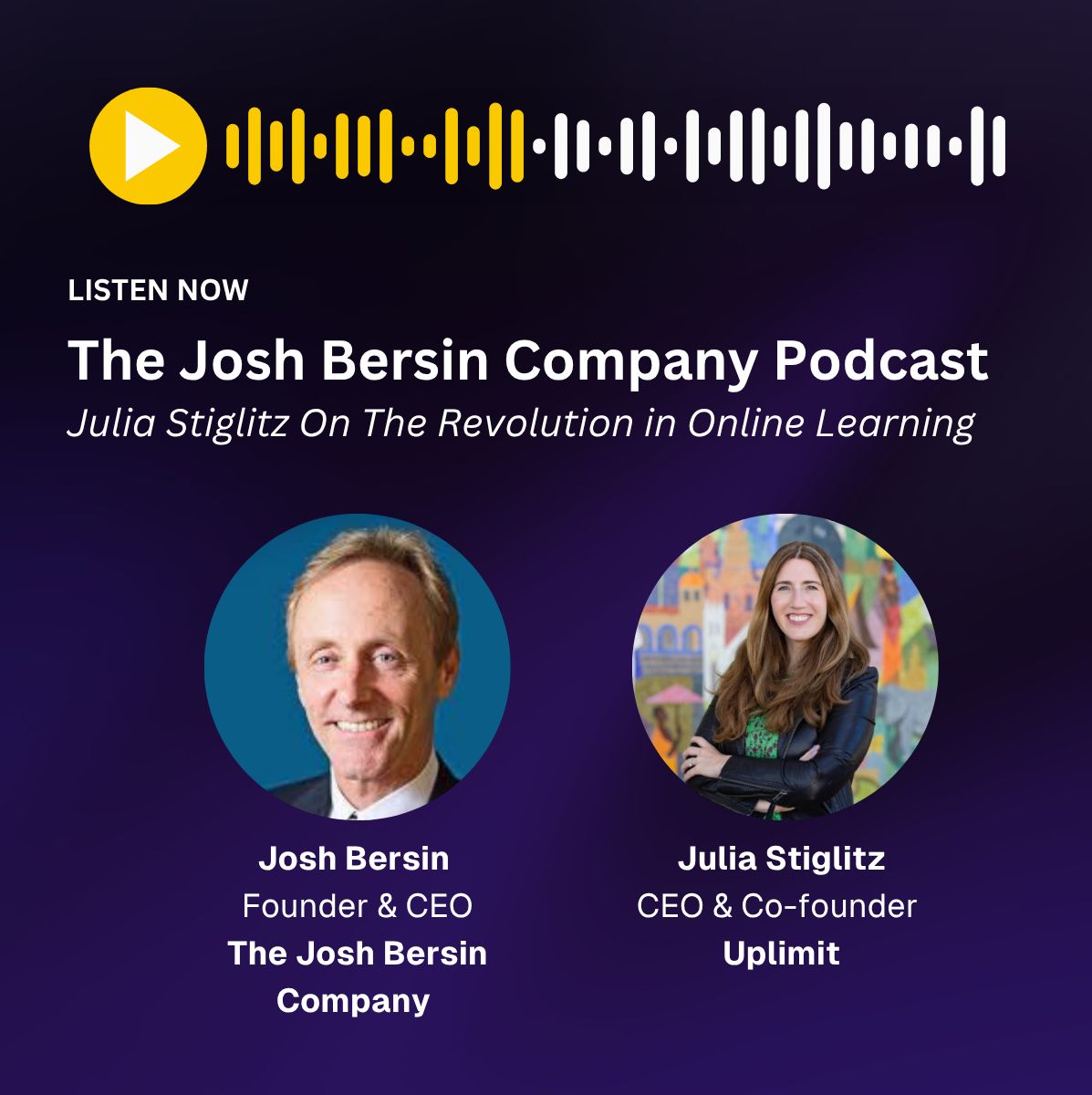
“Content doesn’t get you to real skill development. You have to go further than that.” — Julia Stiglitz, Uplimit CEO
The Josh Bersin podcast has sparked a wave of interest in how AI is reshaping corporate learning. In a recent episode, our CEO Julia Stiglitz shared why the old playbook of buying massive content libraries is giving way to something simpler, faster, and more effective: practice.
Below are the most actionable takeaways from the episode, including quotes and real examples you can use to evolve your own enablement, leadership, and customer education programs.
1) The shift from content to practice
“ I think we got stuck in this pedagogical dead-end of selling people courses because they mimicked classrooms. And now, we can sort of skip that and teach them to do the things that they need to learn, and coach them along the way.” – Josh Bersin
For years, companies bought libraries of thousands of courses and hoped people would find what they needed, then spend hours in front of static learning. AI makes a different model possible. Instead of long classes, teams can deliver short, targeted practice that builds confidence and performance on the job.
In the wild, this could look like ten-minute primers followed by an AI roleplay that lets managers practice delivering feedback, then reflect. It could also be a series of "quick bytes" of product knowledge paired with an AI coach that pushes reps to apply what they just learned.
Why practice works
- Practice drives retention and actual behavior change.
- AI delivers instant, personalized feedback at scale.
- Leaders get visibility into skill progression.
2) AI makes cohort learning scalable
“We know cohort-based learning works… but it’s very difficult to administer. We started with making that easy and far more scalable than it had ever been before.” — Julia Stiglitz
Cohort programs work really well for a group of learners, but without any way to automate them, you have to cap them at a pretty low number of people. Now, with AI, organizations can run cohorts in the thousands without sacrificing quality.
A case-in-point moment in the episode is when Julia mentions Uplimit’s customer, Databricks. Before Uplimit, they were holding live workshops that were capped at ~20 people. Today, Databricks runs weekly cohorts of 1,000+ learners for customer and partner enablement, as well as sales training. An AI teaching assistant joins live sessions, tapping current documentation and historical Q&A to answer questions in real time, so instructors can focus on coaching.
“When you start leveraging technology in smart ways, the live vs. asynchronous equation changes…especially when the goal is efficacy, not check-the-box training.” — Julia Stiglitz
3) Measuring skills, not just seats and clicks
“They’ve never had that data before… to see progression over six months—what people are good at, what they’re not.” — Julia Stiglitz
One global consulting firm uses Uplimit for new consultant training, where over the course of six months, consultants complete rubric-based AI roleplays and assignments that generate a detailed picture of strengths, gaps, and progression. In the end, this means leaders get clear benchmarks of communication effectiveness and can target coaching where it matters.
Why this works for L&D leaders
- Learners can demonstrate capability growth, not just course completions.
- It prioritizes interventions for people who need specific support.
- Learning is tied to specific performance outcomes.
4) Uplimit’s Sparks: fast, focused practice
“Customers started taking our interactive AI exercises and rolling them out without the rest of the cohort infrastructure… the response from learners was great.”
— Julia Stiglitz
Teams like Sony Interactive Entertainment (SIE) and Procore pioneered a lightweight pattern: ship small, timely practice bursts tied to certain business moments. SIE launched feedback dojos before performance reviews: a concise model plus role plays pushed via Slack so managers could rehearse real conversations. And, Procore created Quick Bytes for AI upskilling: short updates paired with an AI socratic coach.
We built a new product based on that pattern: Sparks. These are bite-sized, AI-powered practice modules you can generate from your own product docs or leadership frameworks and push to your teams. They’re especially effective for sales enablement, leadership refreshers, and change communications.
5) Why there aren’t dozens of true AI-native platforms (yet)
“Speed is a differentiator… you launch a feature and three months later it’s old news.” — Julia Stiglitz
Julia mentions in the episode that incumbents face legacy tech and talent challenges. Building generative AI products requires teams who can ship quickly and adapt as models evolve every quarter. That’s hard to do inside large, slower-moving technology stacks, and it’s why a handful of AI-native platforms are setting the pace.
Ready to move from content to capability?
“AI driven learning is a revolution. It changes the role of instructional design and gives people dynamic content. [Uplimit is] taking a very unique, more focused approach.”
– Josh Bersin
If this recap of the Josh Bersin podcast sparked ideas for you, listen to the full conversation.
And reach out to the Uplimit team to bring your ideas to life; we’ll help you launch a practice-first program or cohort-based training that pushes your team forward.